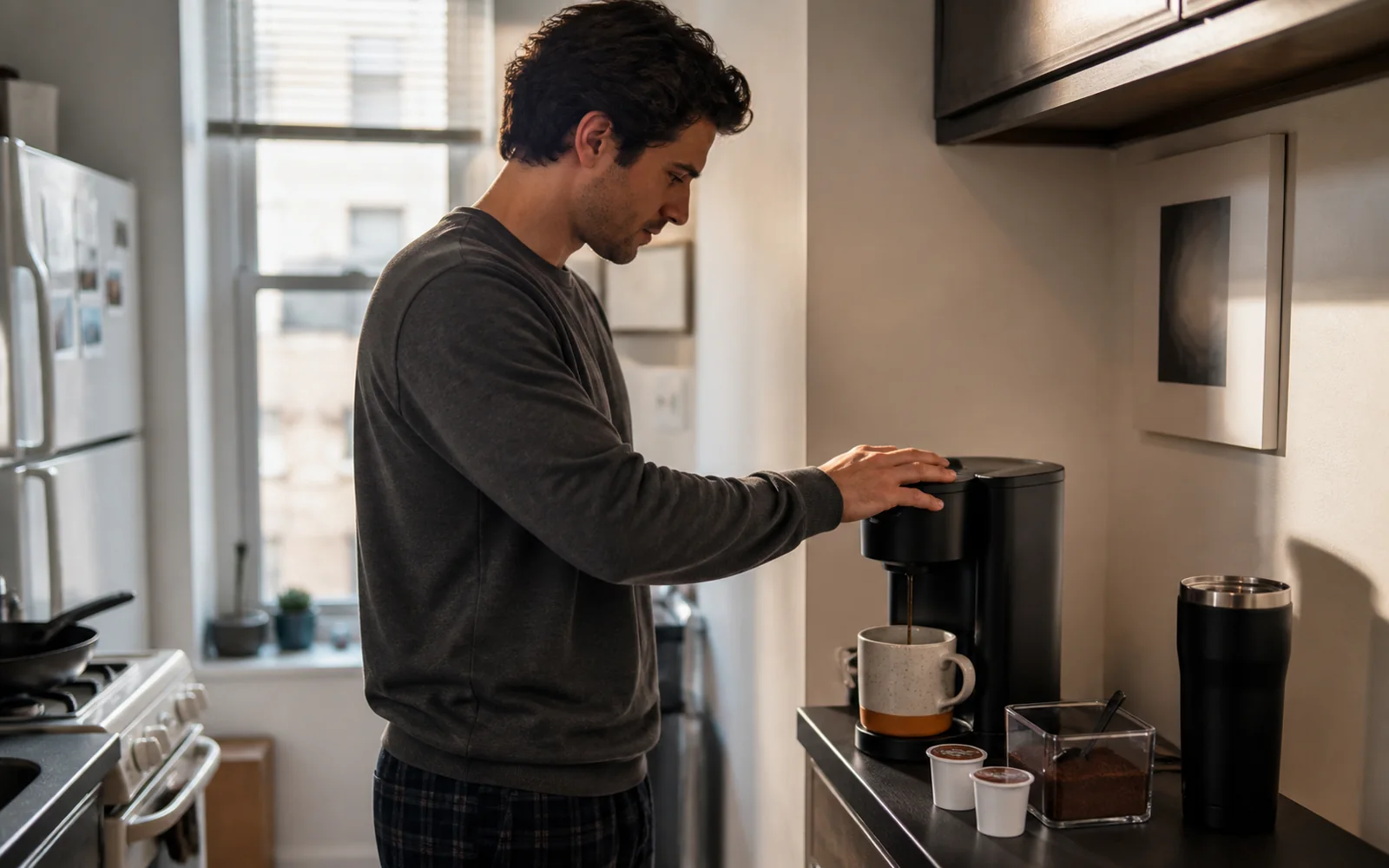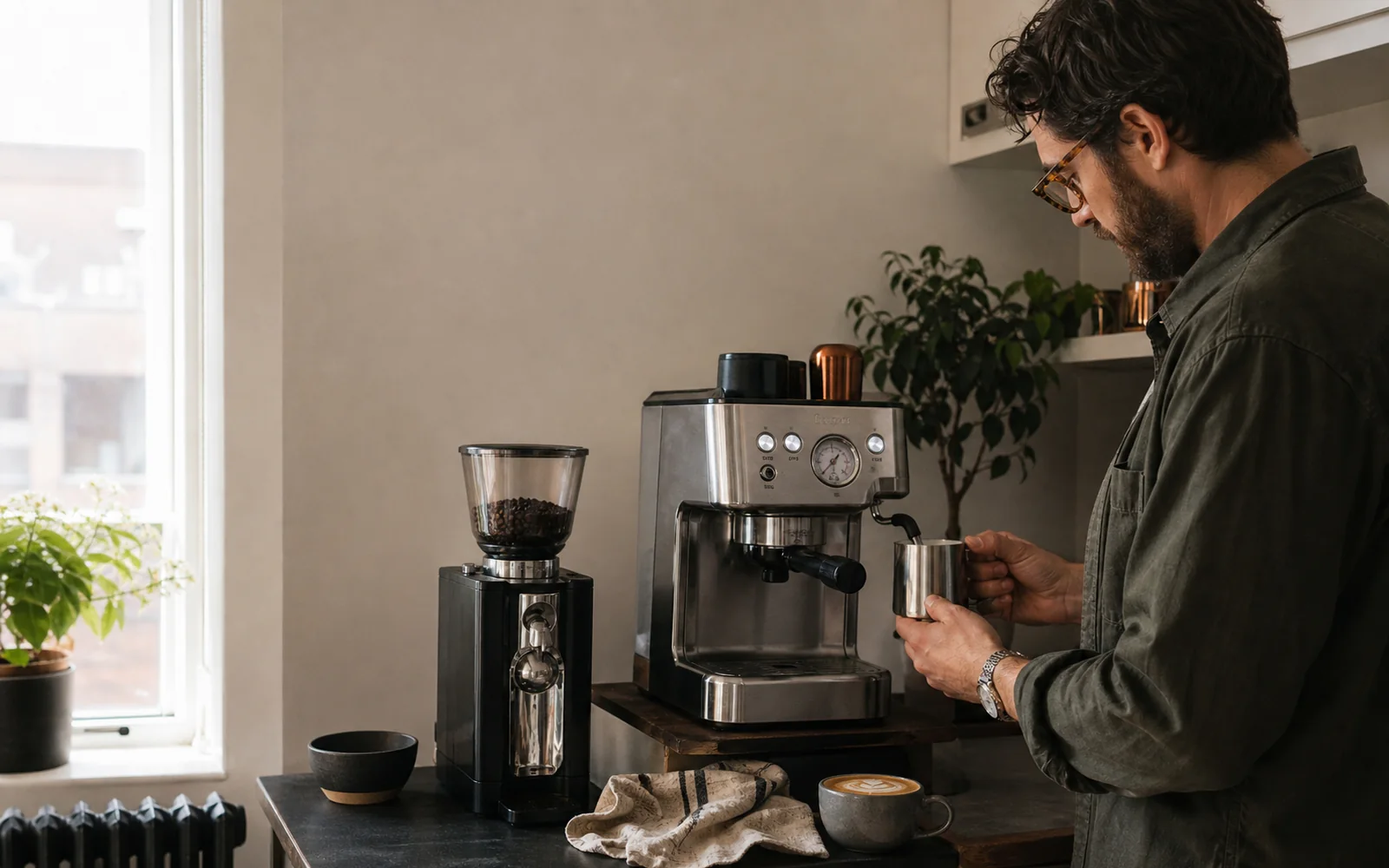
At 6:30 on a workday, Maya wants one cappuccino before her commute without surrendering the only prep space in her apartment kitchen. She has room for a narrow machine and a small grinder, but not for a café-sized setup, and she is willing to learn dosing, tamping, and milk texture if the routine can stay predictable.
That scene captures the CM5418's real appeal: it brings the controls needed to learn espresso into a slim footprint. It also exposes the main buying risk. A narrow machine can still become an inconvenient station when the grinder, pitcher, beans, towel, knock box, and cool-down routine were never included in the plan.
Quick verdict
The CASABREWS CM5418 is a sensible compact option for a beginner who wants hands-on espresso and milk steaming in a narrow kitchen. Its published controls and included dual-wall baskets lower the barrier to a first setup, but it is not a push-button latte machine: you still need suitable coffee preparation, a separate grinder if using whole beans, a milk pitcher, cleanup time, and a cooling step after steaming.
What the CM5418 is—and what it does not automate
The CM5418 is a compact semi-automatic espresso machine. According to CASABREWS, water first passes through a low-pressure pre-infusion stage before the pump builds pressure, while PID control manages brew temperature and the front gauge provides live pressure feedback. The single- and double-shot buttons can be programmed for preferred volumes. Those features support repeatability, but the user remains responsible for the coffee bed and milk texture.
The supplied one-cup and two-cup baskets are dual-wall designs, which can be more forgiving while a beginner learns. The standard published package includes both baskets, a 51 mm aluminum portafilter, a scoop/tamper, and the user manual. It does not turn whole beans into a finished drink: a grinder is separate, and anyone planning lattes or cappuccinos should confirm a suitable pitcher is in the cart.
Three buying priorities
1. Confirm that you want a semi-automatic workflow, then budget for the missing coffee tools
The CM5418 uses a 51 mm aluminum portafilter and includes one-cup and two-cup dual-wall filter baskets plus a scoop/tamper. You load and lock the portafilter, choose the single- or double-shot control, and texture milk manually. Whole-bean drinkers therefore need a separate espresso-capable grinder, and the published accessory lists do not include a frothing pitcher. Add those items to the working budget before comparing the machine's current price.
Use the first comparison below as a reference point, not an automatic winner. The meaningful question is whether its strengths solve your named constraint and whether its tradeoff remains acceptable after the excitement of unboxing.
2. Measure the complete station, not just the machine's 5.47-inch width
CASABREWS lists the body at 5.47 inches wide, 12.28 inches deep, and 11.97 inches high; the Amazon listing gives a weight of 8.6 pounds. That narrow width is useful, but the grinder, portafilter handle, cup area, removable 34-ounce reservoir, cord, and safe hand clearance all need room. Tape the footprint on the counter and leave practical access rather than wedging the machine tightly between a wall and a hot appliance.
Check the exact regional model, included accessories, supported devices, and current documentation before ordering. Product-family names often cover several configurations, and a retailer title may omit the difference that matters to your setup.
3. Plan the brew, steam, cool, and clean sequence before a rushed morning
The machine offers adjustable single- and double-shot volumes, low-pressure pre-infusion, PID temperature control, a pressure gauge, hot-water delivery, and a manual stainless-steel steam wand. After steaming, its guidance says not to brew immediately: the machine must cool, and the flashing one- and two-cup lights indicate high-temperature protection. A purge and cool-down routine is part of ownership, not a defect to discover during the first busy breakfast.
If two choices survive, prefer the one that is easier to return, maintain, and explain. The best long-term purchase is often the product with fewer surprises rather than the one with the most ambitious ceiling.
The exact CM5418 configuration checked for this guide
The link below is for ASIN B09X3WGJ3R, identified on the exact Amazon product page as the CASABREWS CM5418 compact espresso machine. Use the ASIN and model name as the match—not a similar housing or a broad CASABREWS family title—and confirm the current color, included accessories, warranty information, delivery terms, and return window before paying.
CASABREWS CM5418 Compact Espresso Machine (ASIN B09X3WGJ3R)
The exact US model checked for this guide is CM5418BC-UL. CASABREWS publishes a 20-bar Italian pump, low-pressure pre-infusion, PID temperature control, built-in pressure gauge, programmable single- and double-shot volumes, a 51 mm aluminum portafilter with two dual-wall baskets, manual stainless-steel steam wand, hot-water function, 34-ounce removable reservoir, 1350W power, and 120V operation in a 5.47-by-12.28-by-11.97-inch body
Tradeoff: It requires a hands-on grind, dose, tamp, brew, and steam routine; no built-in grinder or automatic milk system is specified, a milk pitcher is not listed with the standard accessories, and the machine needs to cool after steaming before the next extraction.
Where to save—and when to pass
Do not buy the CM5418 for the 20-bar headline alone, and do not read that pump rating as a promise that every shot will extract correctly. Bean freshness, grind, dose, distribution, tamp, warm-up, and workflow still matter. Also pass if you expect an integrated grinder, automatic milk, simultaneous brewing and steaming, or a one-touch cappuccino. The current official and exact Amazon materials describe a 1350W, 120V semi-automatic machine—not an all-in-one bean-to-cup system.
Feature inflation is particularly easy in consumer technology because larger numbers and longer lists are simple to compare. Ownership is less tidy. A feature only has value when your device supports it, your room permits it, and your routine reaches it often enough to notice. Spend first on fit, compatibility, build decisions that affect daily handling, and a return path when fit cannot be known in advance.
Accessories also change the real total. Before treating one option as the cheaper choice, add the cable, mount, adapter, case, memory, subscription, replacement media, or hub the setup actually requires. If those extras solve a real constraint, they belong in the budget. If they merely complete a marketing picture, pause.
Pre-purchase checklist
- Confirm that you want a semi-automatic workflow, then budget for the missing coffee tools.
- Measure the complete station, not just the machine's 5.47-inch width.
- Plan the brew, steam, cool, and clean sequence before a rushed morning.
- Read the exact model's manufacturer documentation and current retailer return terms.
- List required accessories and any recurring service cost before comparing totals.
- Choose the limitation you can accept; no option is best for every person and room.
Frequently asked questions
Is the CASABREWS CM5418 fully automatic?
No. It is a semi-automatic espresso machine. You prepare and tamp the coffee in the portafilter, start a programmed single or double shot, and texture milk manually with the steam wand. It does not provide a one-touch bean-to-cup workflow.
Does the CM5418 include a grinder or milk pitcher?
No built-in grinder is specified, and the current official accessory list names two dual-wall baskets, a 51 mm aluminum portafilter, a scoop/tamper, and the manual—not a milk pitcher. Confirm the exact retailer bundle, then budget separately for an appropriate grinder and pitcher if you need them.
What do the 20-bar pump and pressure gauge tell me?
The manufacturer specifies a 20-bar Italian pump and a built-in gauge that displays pressure during extraction. That is useful feedback, but pump capability is not a guarantee of a good shot. Grind size, dose, puck preparation, coffee freshness, and the machine's operating sequence still affect the result.
Can I brew another espresso immediately after steaming milk?
CASABREWS and the exact Amazon listing warn against brewing immediately after frothing. The machine must cool from steam temperature; flashing one- and two-cup lights indicate the high-temperature state. Follow the product guide's cooling and purge instructions before the next extraction.
How should I use the product button in this guide?
The button is an affiliate link for ASIN B09X3WGJ3R. Use it to check the current configuration, price, availability, shipping, and return terms. Plug or Pass may earn a commission from an eligible purchase without changing the price you pay.
Sources and further reading
Specifications were checked on August 18, 2026 against the exact Amazon product page for ASIN B09X3WGJ3R, the CASABREWS CM5418 product page, and CASABREWS model documentation. This article is based on published information and scenario analysis, not undisclosed hands-on testing.
The official product page and current Amazon bullets both support the 1350W figure used here. Model titles and bundles can change, so verify ASIN B09X3WGJ3R and the CM5418BC-UL model designation before ordering.